


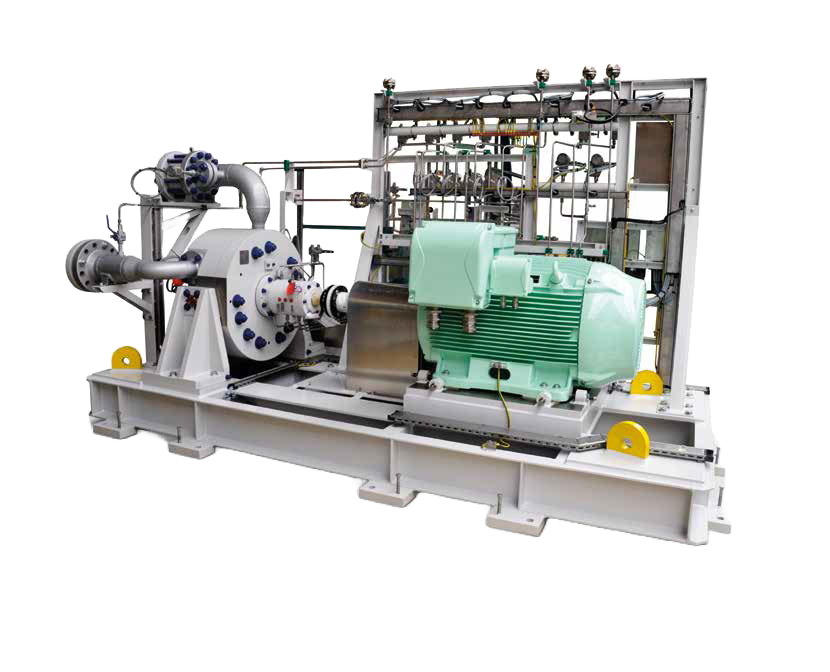
Howden Thomassen, drawing on PeriFlow® technology — a peripheral or low-speed dynamic compressor — offers a particularly competitive compression solution when low to moderate flow rates, high operating pressure and a compact, robust equipment easy to integrate into the plant via its skid design are required. This technology occupies a very well-defined niche among dynamic machines and provides an attractive alternative when the process demands operational simplicity, flow stability and straightforward integration.
PeriFlow® technology is based on a profiled impeller rotating in an annular channel, imparting a helical motion to the gas so that the fluid passes repeatedly through the blades, achieving in a single revolution a compression effect comparable to several centrifugal stages. Within its application niche, it covers pressures of up to approximately 350 bar, flow rates from around 10 to 20,000 am³/h, power outputs of up to approximately 1,000 kW and typical speeds between 1,000 and 6,000 rpm. The possibility of operating with a variable frequency drive allows optimisation of operation and improvement of overall process efficiency.
PeriFlow® is particularly well positioned in applications such as process gas recycling, pressure boosting, gas extraction and gas drying, where its flow control and ease of integration provide clear advantages. In refining and petrochemical applications, its design aligned with API 617 allows its use in services such as reactor feed & recycle of hydrocarbon gases and nitrogen blanketing. In oil & gas midstream environments, it finds application in gas drying and processes associated with molecular sieve regeneration, and also shows good versatility in general industry, for example in CO₂ drying or energy services.
Due to its continuous rotary operation, PeriFlow® delivers a smooth and stable flow, with low vibration and no pulsations, making it attractive in elevated structures or installations with vibration restrictions. Furthermore, it does not require complex anti-surge systems and shows good tolerance to streams containing liquids or small particles, extending its applicability to difficult gases.