
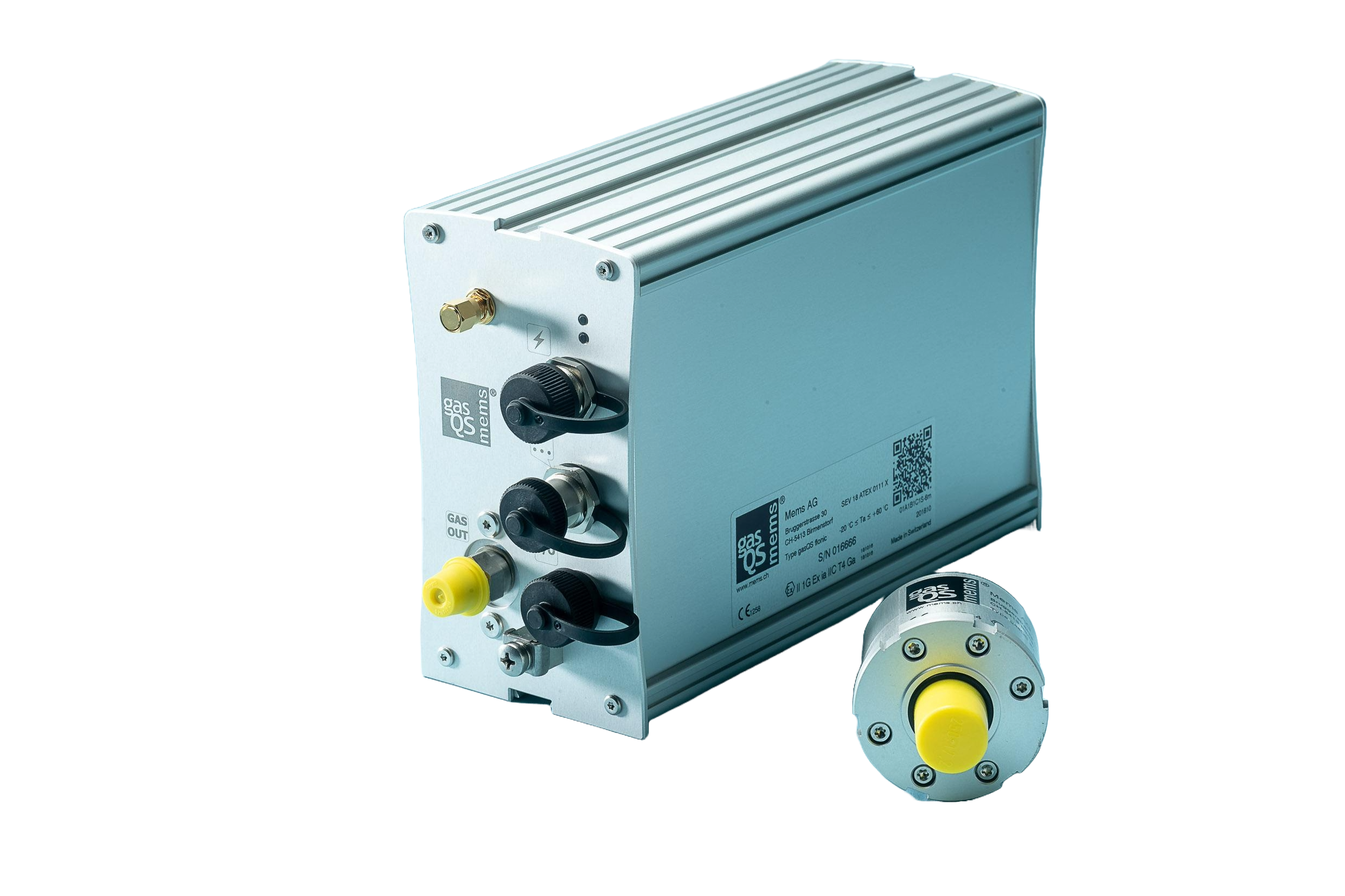
Gas quality analysers (MEMS)

ID: 0002
Gas quality analysers (MEMS)
Description

MEMS AG is a Swiss manufacturer specialised in advanced instrumentation for gas quality measurement. The company was born in 2003 as a spin-off from ABB Corporate Research Switzerland and, after spending its first decade developing static gas meters deployed in millions of homes, broadened its specialisation towards gas quality analysers for industrial, grid and energy billing applications.

Its technological offering is based on the gasQS platform, a correlative measurement solution combining microelectromechanical and microthermal sensors to determine physical properties of the gas in real time. The sensor measures the thermal conductivity and heat capacity of the mixture and, via an additional flow measurement through a critical nozzle, also obtains the density. From these global physical parameters, the equipment calculates key quantities such as Wobbe index, heating value, methane number, compressibility or air/gas ratio, without the need to know the detailed composition beforehand as is the case with a conventional gas chromatograph.

From a metrological standpoint, MEMS provides a particularly solid argument: the gasQS flonic NG has been evaluated by NMi to OIML R140 and certified as CVDD class B, positioning it as a genuine alternative for regulated installations and billing or custody transfer applications. In practical terms, this places its accuracy at a very competitive level compared to a process chromatograph, but with a much more compact, robust and operationally simpler solution.

Another differentiating advantage is maintenance. In standard versions, both flonic and static are notable for requiring no periodic recalibrations or reference gases once supplied, reducing costs and simplifying operation.

For all these reasons, these solutions find application in natural gas networks, biomethane injection, hydrogen blends, biogas plants, gas engines and turbines, industrial burners, fuel cells and energy management or fiscal metering systems.

Applications

Continuous on-line natural gas quality measurement (heating value, density, Wobbe index and methane number)
Energy fiscal metering
Hydrogen blend monitoring
Binary/ternary gas blend monitoring
Blending operation control
Quality control in biogas and biomethane
LNG / liquefied natural gas (regasified) applications
Synthetic gas and power-to-gas mixture monitoring (syngas / PtG)
Industrial burner optimisation
Gas engine and CHP plant optimisation
Gas consumption optimisation in combustion processes

Equipment

Gas quality analyser – gasQS Static
Gas quality analyser – gasQS Flonic

Other Features

FLONIC: oriented towards applications requiring a more comprehensive gas quality reading and flexible integration into process or fiscal measurement systems. Its architecture combines a CMOS microthermal sensor, a critical nozzle and two valves, allowing measurement of thermal conductivity, heat capacity and relative density of natural gas to correlate variables such as density, superior and inferior Wobbe index, superior and inferior heating value, H₂ content, compressibility factors and methane number. Depending on version, it offers typical accuracies of the order of ±0.4% for density, ±0.8 to ±1.0% for heating value and ±1.0 to ±1.3% for Wobbe index, with very low repeatabilities of the order of ±0.03 to ±0.04% for several of these quantities. Furthermore, it does not require carrier gases, is simple to integrate and can be adapted to different gas families, including scenarios with hydrogen, biomethane or LNG content.

STATIC: designed as the most compact and rapid solution for on-line measurement, particularly suitable for binary or quasi-binary mixtures and applications where direct installation, minimal line intrusion and near-instantaneous response are valued. It operates with a high-sensitivity microthermal sensor, simple two-wire connection and analogue 4–20 mA output; furthermore, it incorporates no moving parts, operates with pressure compensation and can be mounted directly in-line via a threaded connection. In binary mixtures, for example biogas, it can determine gas percentage, density and heating value with typical accuracies of ±1% of the measured value and repeatabilities of ±0.1%. For hydrogen applications, it also allows measurement of concentration or purity with typical T90 response times of 2 seconds, accuracies of up to ±0.1% for H₂ in CH₄ or ±500 ppm for hydrogen purity, depending on version.

Related equipment